Tag Archives: mosaic

The Rho Ophiuchi Complex:

My Biggest Mosaic Yet

A Stellar Nursery Next Door

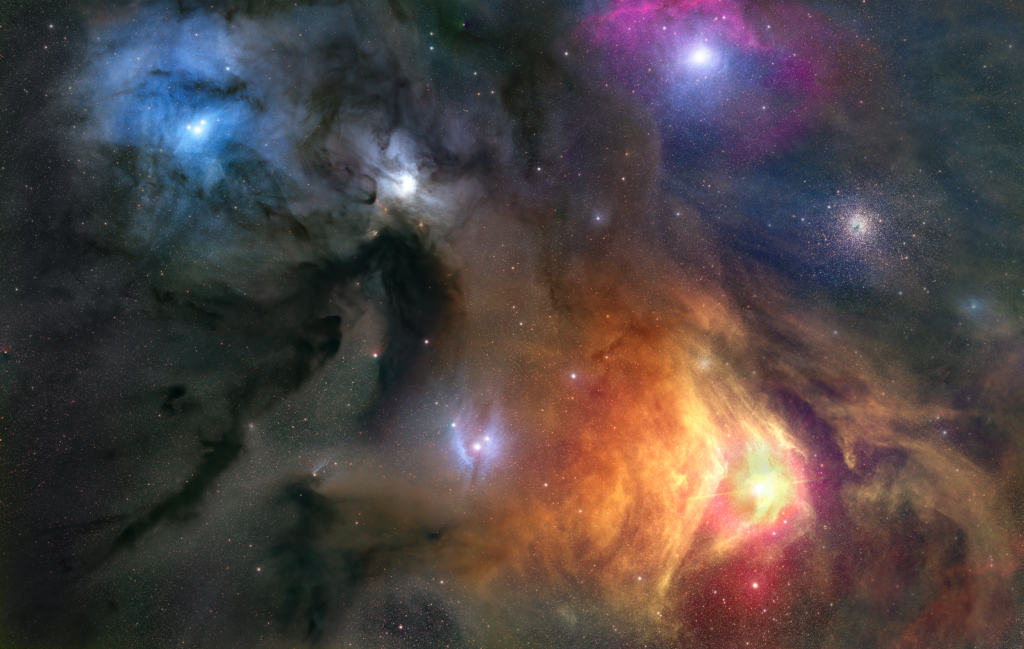
At about 460 light-years away, Rho Ophiuchi is one of the closest star-forming regions to Earth — practically in our backyard, cosmically speaking. It’s dense with young stars still wrapped in the gas and dust they formed from, some barely a hundred thousand years old. A few of the youngest already have their own circumstellar disks — the raw material for future planets — which is part of why this region turns up in professional astronomy too: it’s home to the first brown dwarf ever discovered inside a star-forming region, and it’s one of three regions ALMA’s ongoing AGE-PRO survey is using right now (image below courtesy NASA) to map how planets actually form from this kind of raw material. ALMA’s capture here is of a tiny portion of my image shows the brown-dwarf stars being monitored for planet formation.

Atacama Large Millimeter/submillimeter Array (ALMA), is the largest radio telescope on earth. Astronomers for the first time found that the outer region of a dusty disc encircling a brown dwarf contains millimetre-sized solid grains like those found in denser discs around newborn stars. The surprising finding challenges theories of how rocky, Earth-scale planets form, and suggests that rocky planets may be even more common in the Universe than expected. (image provided under Creative Commons 4.0 via ALMA).

Antares — the huge gold-orange star anchoring the lower left portion of this frame, is a red supergiant near the end of its life, and the dust around it glows in warm oranges and reds where it’s lit by the star itself. Just above it sits M4, a globular cluster packed with hundreds of thousands of stars, some of the oldest in the galaxy. M4 and Antares look like neighbors in this frame, but they’re not even close: Antares is about 550 light-years out, M4 is roughly 6,000 — over twelve times farther, just lined up along the same line of sight.

Up in the left upper corner of the frame, that cool blue haze is a completely different kind of nebula — a reflection nebula, where starlight from the star ρ Ophiuchi scatters off dust rather than exciting it into glowing. It’s the same physics that makes the sky blue, just lit by a different star. Thread your eye through the darker channels cutting across the frame to lower left and you’re looking at the raw material for the next generation of stars here — cold dust so thick it blocks the light behind it entirely.

Why This Needed Four Panels:

And a Plate-Solving Lesson

Rho Ophiuchi spans a wide enough patch of sky that a single frame from my telescope couldn’t come close to covering it, so this became a 4-panel mosaic — planned, shot, and processed as four separate sub-projects that had to line up seamlessly in the end. The view here, which could be even wider to capture more aspects of these objects, spans some 10 full moons run edge-to-edge. I do wish we could see these with our own eyes. Maybe our future robotic eyes will help.

Actually combining these was a huge challenge. I ended up The plate-solving step taught me something I hadn’t run into before. On a target this size, “Rho Ophiuchi” isn’t a single point — the named object isn’t centered in every individual panel. I initially let the solver look up “rho ophiuchi” automatically and seed itself from that, and it failed outright on more than one panel, even with plenty of stars to match against. The fix was to manually find each frame’s actual center — using a reference image of the area — and feed that in directly instead of trusting the automatic lookup. This insight came from Claude Code, which I’ve been teaching some of the ins and outs of my astrophotography exactly for this type of trouble-shooting. Worth remembering for anyone mosaicking a large, spread-out target: don’t trust name-based lookup for anything but the smallest single-frame shots.

The Data

FilterFramesSub LengthTotal
Luminance533300s44h 25m
Red338300s28h 10m
Green343300s28h 35m
Blue350300s29h 10m
Total1,564130h 20m

That Panel 2 number is the story behind this whole project. Rho Ophiuchi never climbs very high in the sky from Starfront’s latitude to begin with, so the usable imaging window each night is short — and by the time I got to the last panel, that window (and the season) was closing fast. I shot the panels sequentially rather than concurrently, so the exposure imbalance compounded: less time available per night, fewer nights left before the target dropped out of reach. Panel 2 paid the price.

What Went Wrong (and How I Fixed It)

The imbalanced Panel 2 didn’t just look thinner in the final blend — it caused real downstream problems.

Panel misalignment. With fewer stars available on the weakest panel, the astrometric solve there matched far fewer reference points than the other three, which meant less precision holding that panel in place during registration. It showed up as a directional light/dark split cutting across bright stars near the seams — two panels quietly disagreeing on exactly where a star sat. Switching to a solver with a denser star catalog and a proper distortion model brought cross-panel agreement down to a fraction of a pixel.

Panel brightness and alignment – shown here by the checkerboard – both needed to be addressed before I could move on the fun part of the project.

The checkerboard. Even after registration was solid, the some channels of the merged mosaic showed visible rectangular tiles of different brightness — panels sitting at its own background level. Gradient-removal tools could’t fix it; they’re built to flatten variation within one image, not force two separate images to the same absolute level. So it was back to the manual fix: measure each panel’s true background, pick the darkest one as the target, and nudge every other panel down to match with a direct pixel offset.

After correction – uniform background, no seams visible.

Doubled stars. Small, faint stars across every panel had a fainter ghost stuck a few pixels off to one side — consistent distance, but no consistent direction. That second part matters: a tilted sensor or misaligned optic produces ghosts that point toward or away from the center of the frame; I checked, and these don’t. What’s left is interpolation-kernel ringing — the resampling method used to align each sub-frame during stacking has small negative side-lobes that ring around small, faint stars.

Fixing it took a wrong turn first. I switched the interpolation setting, reprocessed a test panel, and got exactly the same result — turned out a separate, simplified tool I’d been using without realizing it (PixInsight’s FastIntegration instead of the much more robust Weighted Batch Preprocessing) was quietly running the actual alignment step with its own interpolation setting, ignoring the change I thought I’d made. Once I found and changed the setting that actually mattered, the ghosts didn’t disappear completely, but they came in noticeably fainter — down to roughly a fifth of their previous brightness relative to the star itself, which in practice is the difference between “visible if you go looking” and “not registering as an artifact.” I haven’t reprocessed the full mosaic with this fix, but it’s the default for my next one.

Test One – one real star alongside it’s ghost. Note the extreme pixelation and similarity.
Post Testing – soft, less pixelated ‘real’ star, and a greatly minimized secondary.

The green cast. My initial full-color composite came out strongly, unmistakably green at one point in processing — not a subtle tint. The cause was actually mundane and easily corrected: I’d stretched the panels as a linked set before running color calibration, which reliably produces exactly this kind of cast. Running Spectrophotometric Color Calibration (SPCC, a function within Pixinsight). SPCC does colour calibration; it calculates the best fit of the B/G and R/G color channel ratios on the basis of a massive catalog of stars in the image, and then adjusts the channel balance so that R=G=B so stars, nebula and galaxies are correct based on professional photometry of the night sky. Executing SPCC, the next steps was to apply a linked stretch provided the realistic colors as captured by my RGB filtered camera.

The ‘just out of stacking’ green color cast is quite typical for astro images like this. By using pectrophotometry–based Color Calibration in PixInsight, I applied a huge database of the stars in our night sky to adjust colors to match the known-spectrometry of every star in the final image to match reality.

For the full technical write-up on all of this — settings, folder structure, and everything else that broke along the way — I put together a companion field-notes doc: Multi-Panel Mosaic Processing — Field Notes.

This is the widest captures of the sky and as a result the longest project I’ve built to date, and I’m already eyeing the dark nebula trailing off toward the lower-left edge of this frame for a future extension next Spring. Watch this space.