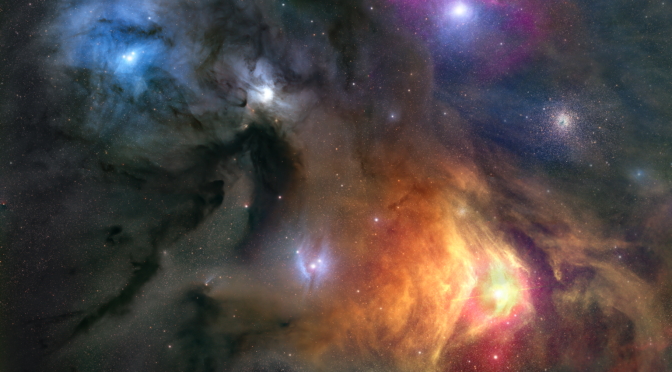
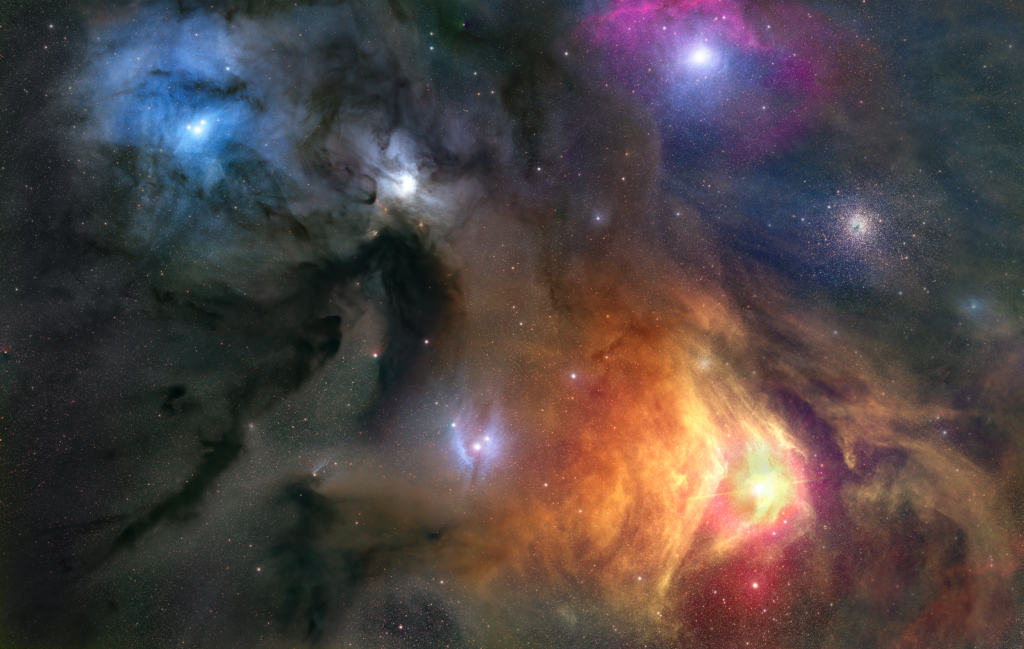
To my eye, this is one of the most beautiful patches of the night sky. CLICK on IMAGE above to view full-screen
A Stellar Nursery Next Door
At about 460 light-years away, Rho Ophiuchi is one of the closest star-forming regions to Earth — practically in our backyard, cosmically speaking. It’s dense with young stars still wrapped in the gas and dust they formed from, some barely a hundred thousand years old. A few of the youngest already have their own circumstellar disks — the raw material for future planets — which is part of why this region turns up in professional astronomy too.
A Deep Narrowband Study of One of Amateur Astronomy’s Recent Discoveries
In an era where we think everything in the night sky has been catalogued, it’s remarkable that a massive nebula nearly a degree across remained undiscovered until 2011. The Giant Squid Nebula (Ou4) is a testament to what modern narrowband imaging can reveal—and a reminder that amateur astrophotographers are still making real discoveries.
Of all the objects in the night sky, few capture the imagination quite like M42—the Great Orion Nebula. Visible to the naked eye as a fuzzy “star” in Orion’s sword, even under moderately light-polluted skies, it’s been observed for millennia. This was one of the first deep-space objects I ever tried to photograph (back around 2018), but there’s always something new to discover.
From Starfront Observatories near Brady, Texas – IC 2118, the Witch Head Nebula, emerges from the cosmic darkness in not too far away in our nighttime sky from the famous Great Orion Nebula. This object, however, is a faint reflection nebula sitting approximately 900 light-years away, meaning the photons in this image began their journey around the year 1125 – during the height of the Crusades and the construction of Europe’s great cathedrals.