
A Familiar Face, Finally Done Right
If you’ve ever looked up at the winter sky and noticed a tight little knot of blue-white stars, you’ve already met the Pleiades. M45 is one of those objects that’s been observed, mythologized, and photographed more times than almost anything else in the sky — and yet there’s a reason people keep coming back to it.
This was a challenging target to do justice to, and honestly one I’ve wrestled with for a while. The seven brightest stars (the “Seven Sisters” of Greek mythology) are so intensely bright that managing them while simultaneously pulling out the faint surrounding nebulosity is a real balancing act. The nebula here isn’t an emission nebula like most of what I’ve been shooting lately — the Pleiades are passing through a completely unrelated cloud of interstellar dust, which scatters the blue light from those hot young stars. It’s a reflection nebula, and that’s what gives it that distinctive, almost silky blue glow.
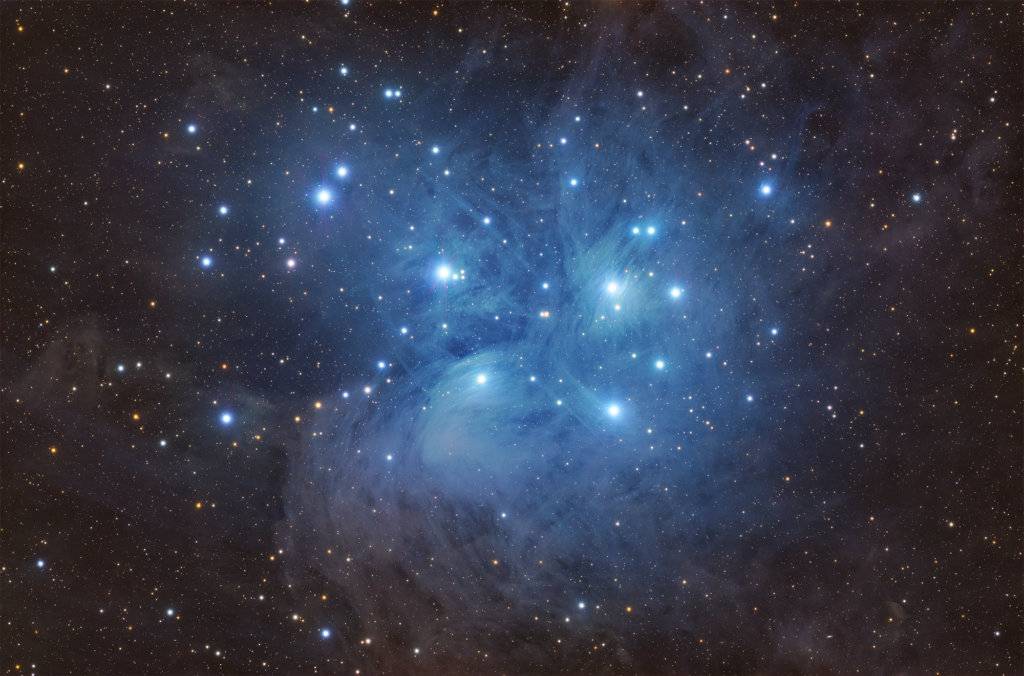
The swirling, filamentary structure wrapping around the stars — particularly the bright billowing cloud around Merope in the lower center — is called the Merope Nebula (IC 349). Those streaks and wisps aren’t random; they reveal the structure of the dust cloud itself, shaped by the radiation pressure from the stars moving through it.
Why HOO + RGB?
The Pleiades are primarily a broadband target — most of the detail lives in that scattered blue starlight, not in narrowband emission. But I added Hydrogen-alpha and Oxygen-III data on top of the RGB to bring out the faint background nebulosity that broadband alone struggles to reveal against the brightness of the cluster. The HOO data — mapped to a red/blue blend — helped define the faint outer dust tendrils that you can see creeping in from the edges of the frame, including the subtle brownish-gray integrated flux nebula (IFN) that permeates the background at truly dark skies.
At 42+ hours of total exposure time, this is one of the deeper looks I’ve taken at this target. The luminance data alone (nearly 15 hours) did a lot of the heavy lifting for fine structure in the dust.

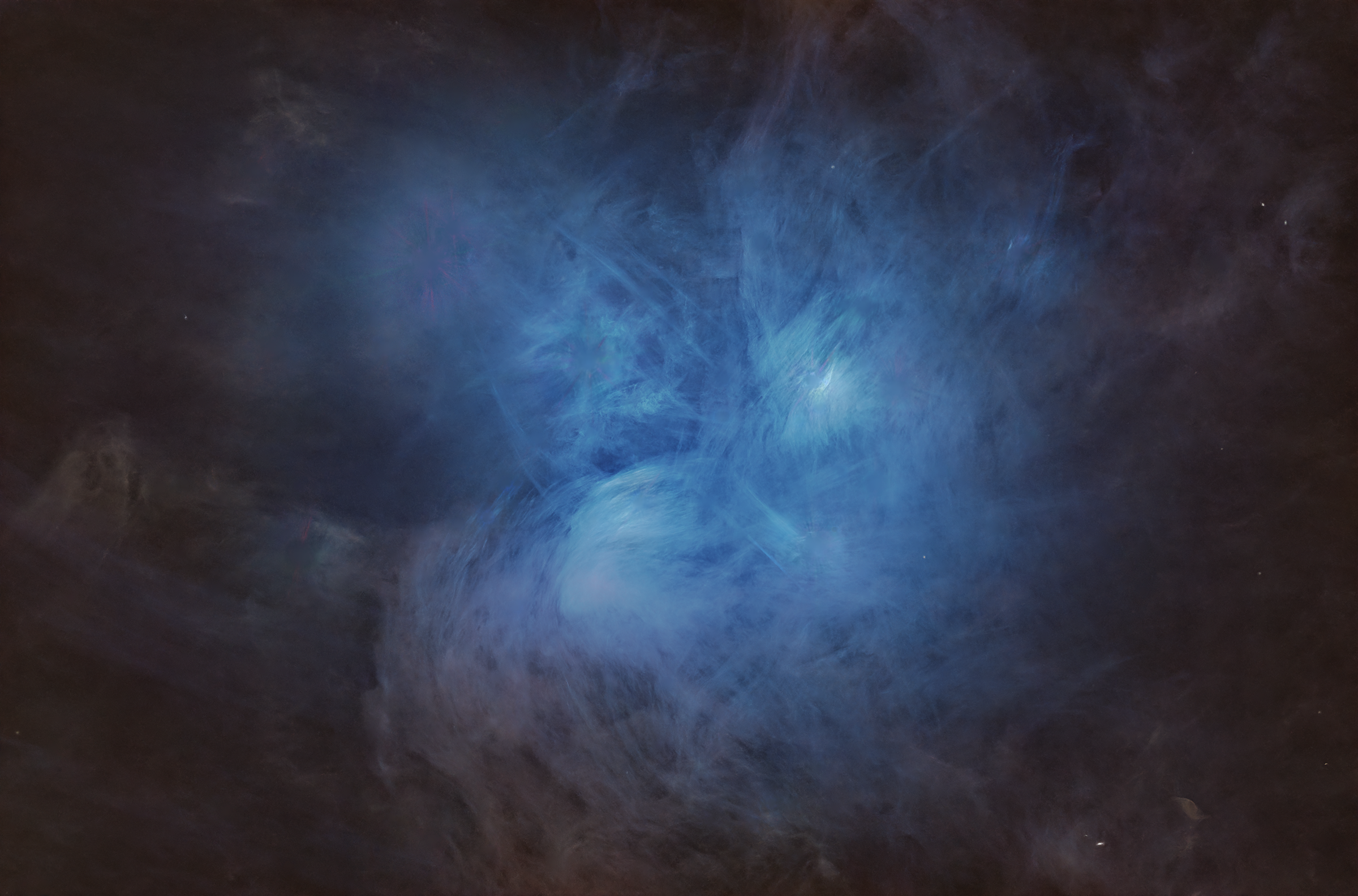
off the fascinating details of this nebula.
The Details
The Pleiades sit about 440 light-years from Earth — close enough in cosmic terms that they’re one of the few star clusters whose distance can be measured directly through stellar parallax.
Stellar parallax works by observing a star’s apparent shift in position against more distant background objects as Earth moves from one side of its orbit around the Sun to the other. By measuring this tiny angular shift, astronomers use trigonometry to calculate the distance.
The cluster is young, only about 100 million years old. The stars are traveling through space together as a group, and in another 250 million years or so they’ll have dispersed and the cluster as we know it will be gone. Catch it while you can, I suppose.
The light in this image left during the early Jurassic 🦖 period, when dinosaurs were just getting started. Every photon traveled roughly 2.5 quadrillion miles to reach my telescope in Brady, Texas. 🌌
Total integration: 42 hours, 30 minutes from Starfront Observatories, Brady, Texas.
- Luminance: 14h 50m
- Hα: 12h 15m
- RGB: R 4h 30m / G 4h 5m / B 2h 50m
- OIII: 4h
Equipment:
- Telescope: William Optics Gran Turismo 81mm WIFD
- Camera: ZWO ASI2600MM Pro
- Mount: ZWO AM5
- Filters: Antlia 3nm narrowband (Hα, OIII) and RGB
- Software: N.I.N.A., PHD2, PixInsight, Photoshop, PiMagic Studio, Russ Croman’s Xterminator Suite
Full acquisition details on Astrobin.
Processing Notes
Getting the stars under control was the main challenge here. The seven brightest Pleiades are genuinely overexposed in almost any reasonable exposure that’s also trying to capture the surrounding nebulosity — there’s just no way around it without HDR blending techniques. StarXTerminator made it possible to work on the nebula and stars separately, which is how you end up with both well-controlled star halos and visible dust structure at the same time. The HOO blend required some careful color calibration to keep the result looking natural rather than pushing the blues into territory that looks artificial.
This one took some work, but I’m happy with where it landed.