A Deep Narrowband Study of One of Amateur Astronomy’s Recent Discoveries
In an era where we think everything in the night sky has been catalogued, it’s remarkable that a massive nebula nearly a degree across remained undiscovered until 2011. The Giant Squid Nebula (Ou4) is a testament to what modern narrowband imaging can reveal—and a reminder that amateur astrophotographers are still making real discoveries.
Of all the objects in the night sky, few capture the imagination quite like M42—the Great Orion Nebula. Visible to the naked eye as a fuzzy “star” in Orion’s sword, even under moderately light-polluted skies, it’s been observed for millennia. This was one of the first deep-space objects I ever tried to photograph (back around 2018), but there’s always something new to discover.
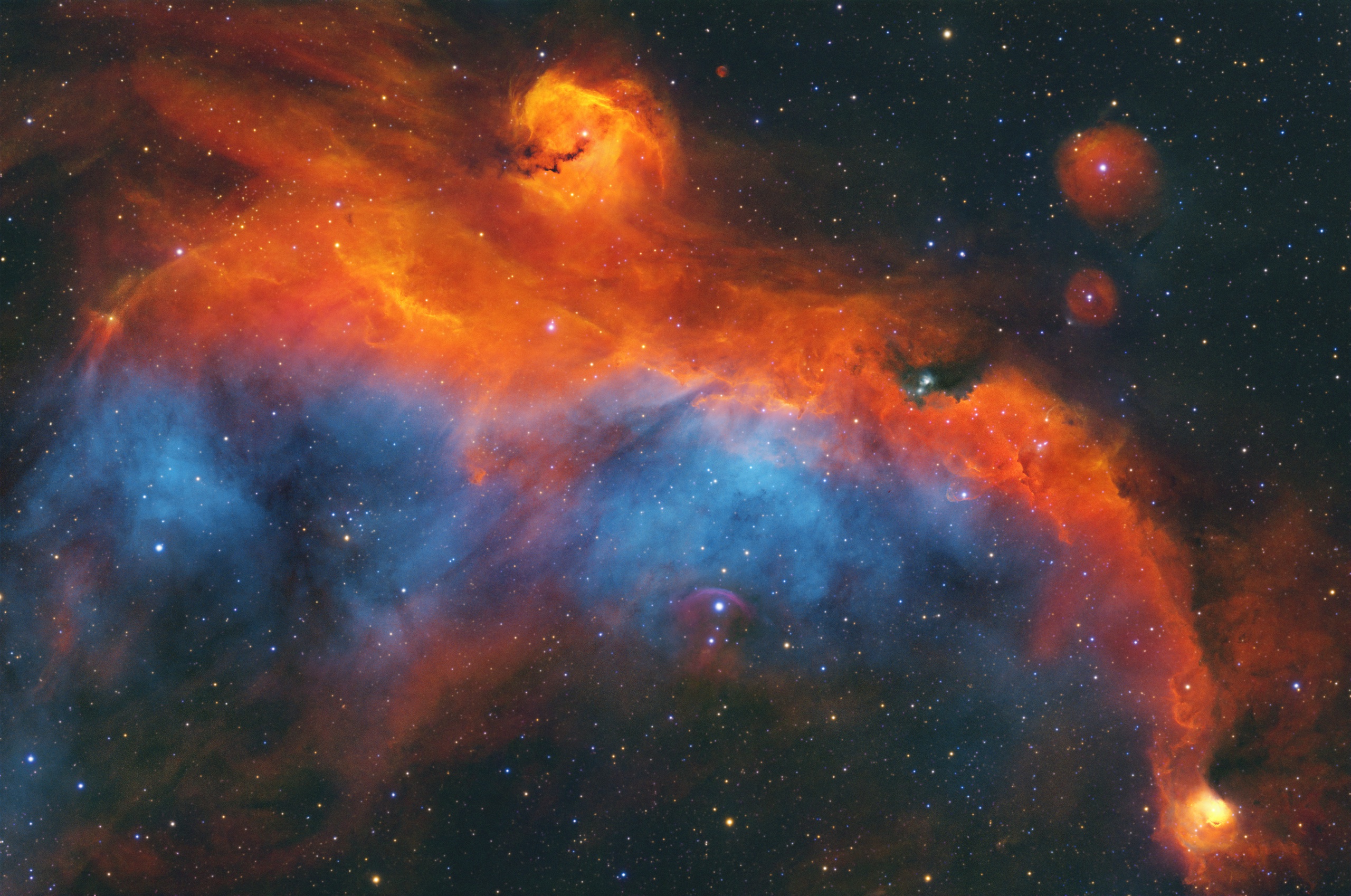
IC2177, : The Seagull Nebula. Flying high in our wintertime skies, here i’ve captured this object in a combination of two distinct treatments. SHO (sulfur-2, hydrogen-alpha and oxygen-3) also known as the ‘Hubble Palette’ – a way of mapping deep-space objects wavelengths to a format for the human eye. See below for another version that excludes the blue oxygen-3 and shows more of the subtle gradient between deeper reds, pinks, oranges and yellows. More info here on my Astrobin.com site.
In case you’ve missed my celestial (and cocktail) updates, I’m back and kicking, and ramping my astrophotography into high gear. This is one of many deep-space images to come from my remote telescope rig located at @starfront_observatories in truly dark skies near Brady, Texas (see caption below).