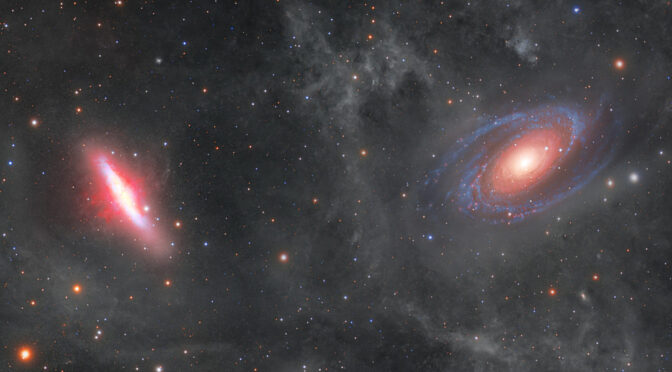
Some targets earn their reputation. M81 and M82 — Bode’s Galaxy and the Cigar Galaxy — are staples of the spring sky, the kind of pair that shows up in every beginner’s first light report and every veteran’s “I need to do this one properly” list. I finally got around to doing it properly.
A Galaxy Group in the Cosmic Neighborhood
What you’re looking at in this image isn’t just two famous galaxies. It’s a whole gravitational family, the M81 Group, a collection of around 40 galaxies bound together by mutual gravity, sitting roughly 12 million light-years from Earth. That sounds impossibly far, but in the grand scheme of the universe, it makes them close neighbors. Our own Milky Way belongs to a similar family called the Local Group, which includes Andromeda, the Triangulum Galaxy, and a few dozen smaller satellites. The M81 Group and our Local Group aren’t gravitationally bound to each other, but they’re near-neighbors in the same larger cosmic structure, the Virgo Supercluster. Think of them as two small towns in the same county.
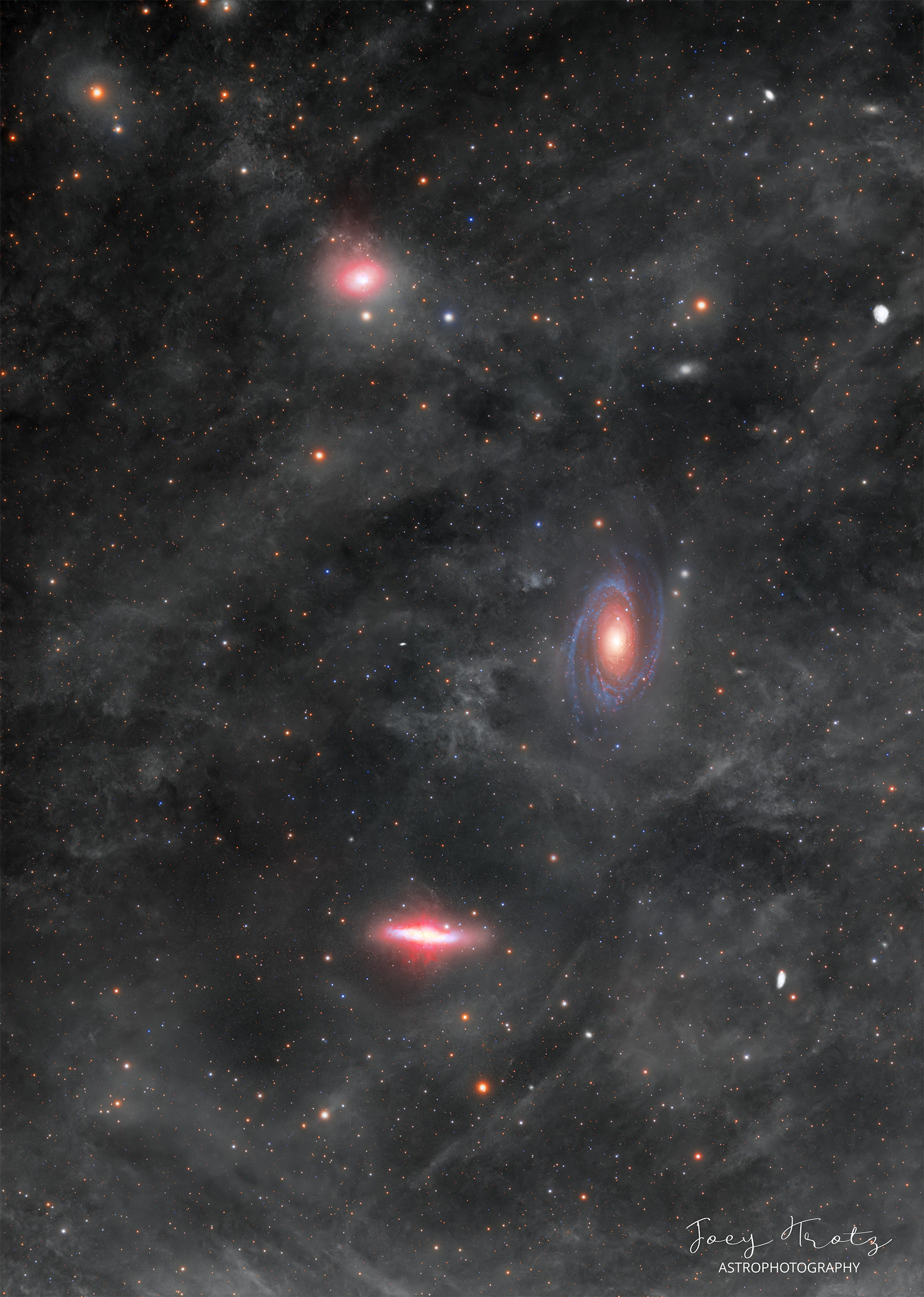
Within the M81 Group, three galaxies dominate. M81 (Bode’s Galaxy) is the patriarch — a grand design spiral and the gravitational anchor of the whole system. M82 (the Cigar Galaxy) is the turbulent neighbor, a starburst galaxy being kneaded and tormented by M81’s tidal forces. And NGC 3077, visible in the upper portion of this frame, is the quieter third member, a smaller elliptical showing the scars of the same gravitational interaction — distorted edges and dust clouds that are the wreckage of a cosmic encounter that happened around 300 million years ago.
That encounter stripped hydrogen gas away from all three galaxies, created long filamentary bridges of neutral hydrogen connecting them, and funneled gas into the centers of M82 and NGC 3077 — triggering the intense star formation that makes M82 so dramatic today.
The IFN
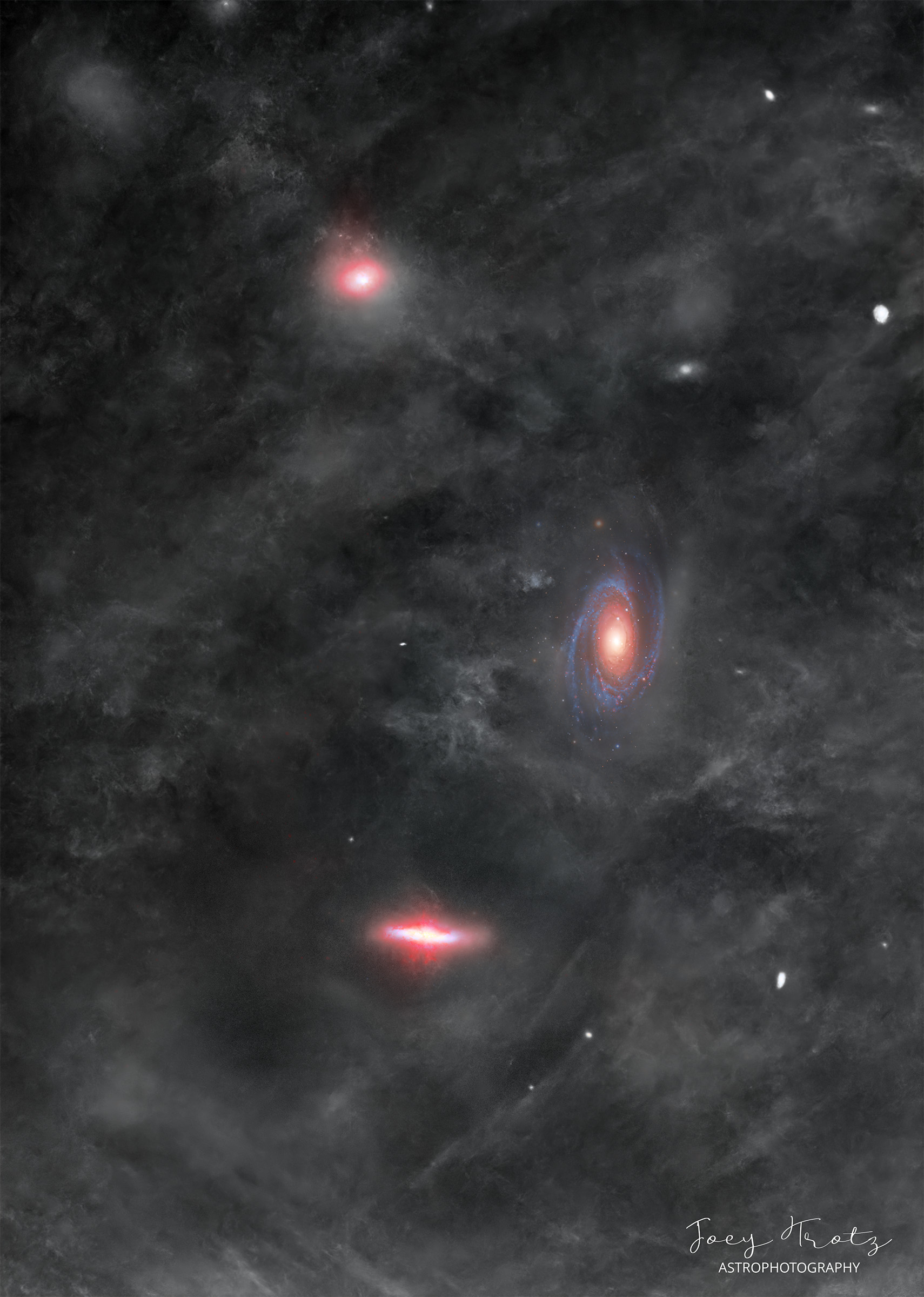
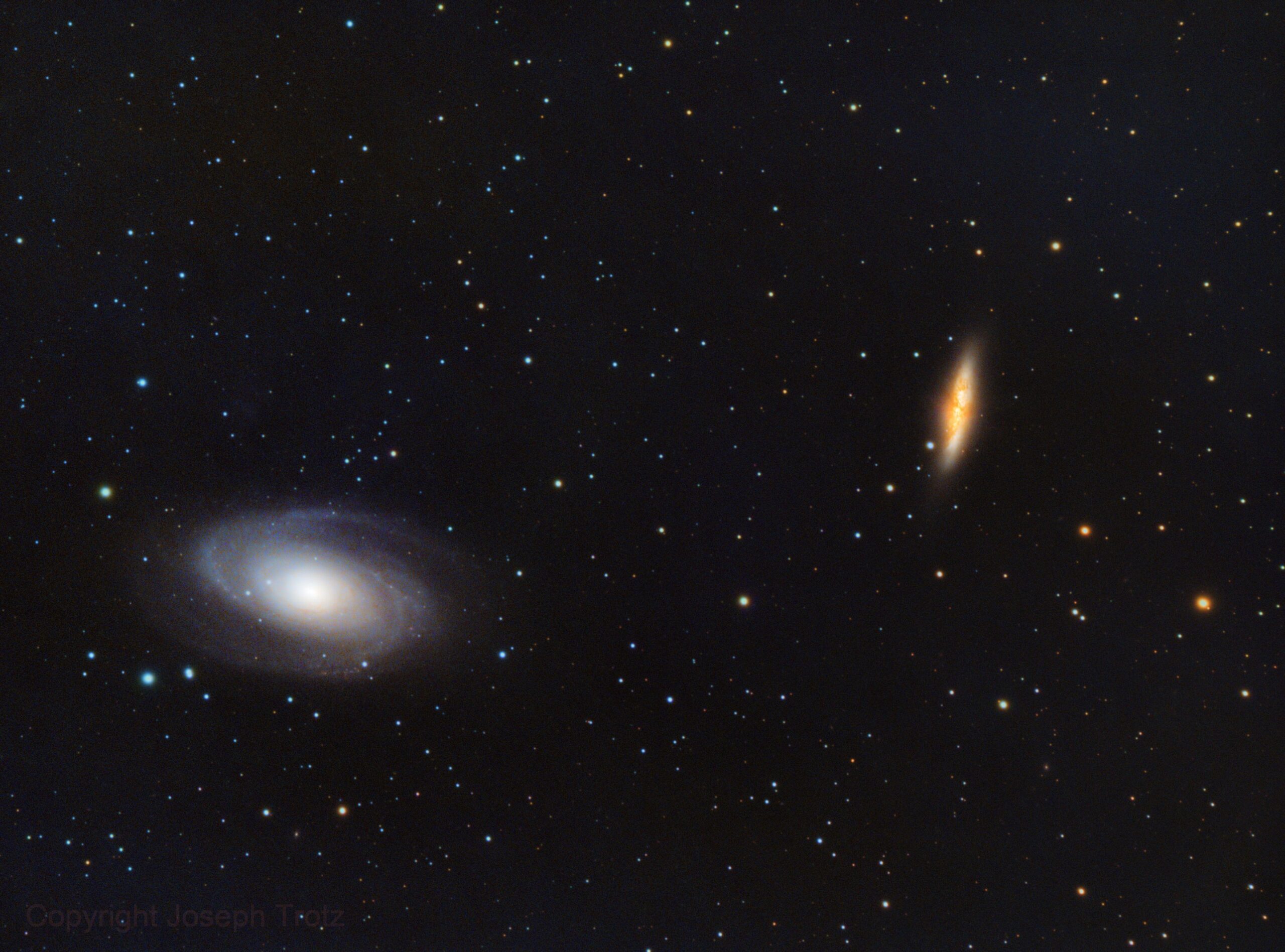
What drew me back to this target wasn’t just the galaxies. It was the Integrated Flux Nebula (aka IFN) that drapes across this entire region of Ursa Major like ghostly cirrus clouds. Unlike emission or reflection nebulae energized by nearby stars, IFN is something stranger: faint galactic cirrus illuminated by the cumulative light of the entire Milky Way. This works in the same way ‘Earthshine’ reflects back just enough reflected light from our sun onto the moon that we can see both a thin crescent but also the outline of the rest of the moon. These clouds of Flux exist above the galactic plane, which is why this region, far from the noise of the galactic core, is one of the best places in the sky to find it. To observe in this much detail, you need dark skies, careful processing, and time. A lot of time. For comparison, here’s an image of M81 & M82 I took back in 2023 with all of 11 hours of exposure. The IFN is nowhere to be found!
The Data
Imaging from Starfront Observatories, Brady, TX. 24 nights, March 12 – April 9, 2026.
| Filter | Frames | Sub Length | Total |
|---|---|---|---|
| Luminance | 183 | 300s | 15h 15m |
| Red | 104 | 300s | 8h 40m |
| Green | 103 | 300s | 8h 35m |
| Blue | 104 | 300s | 8h 40m |
| Hα (2.5nm) | 178 | 600s | 29h 40m |
| Total | 672 frames | 70h 50m |
What You’re Looking At
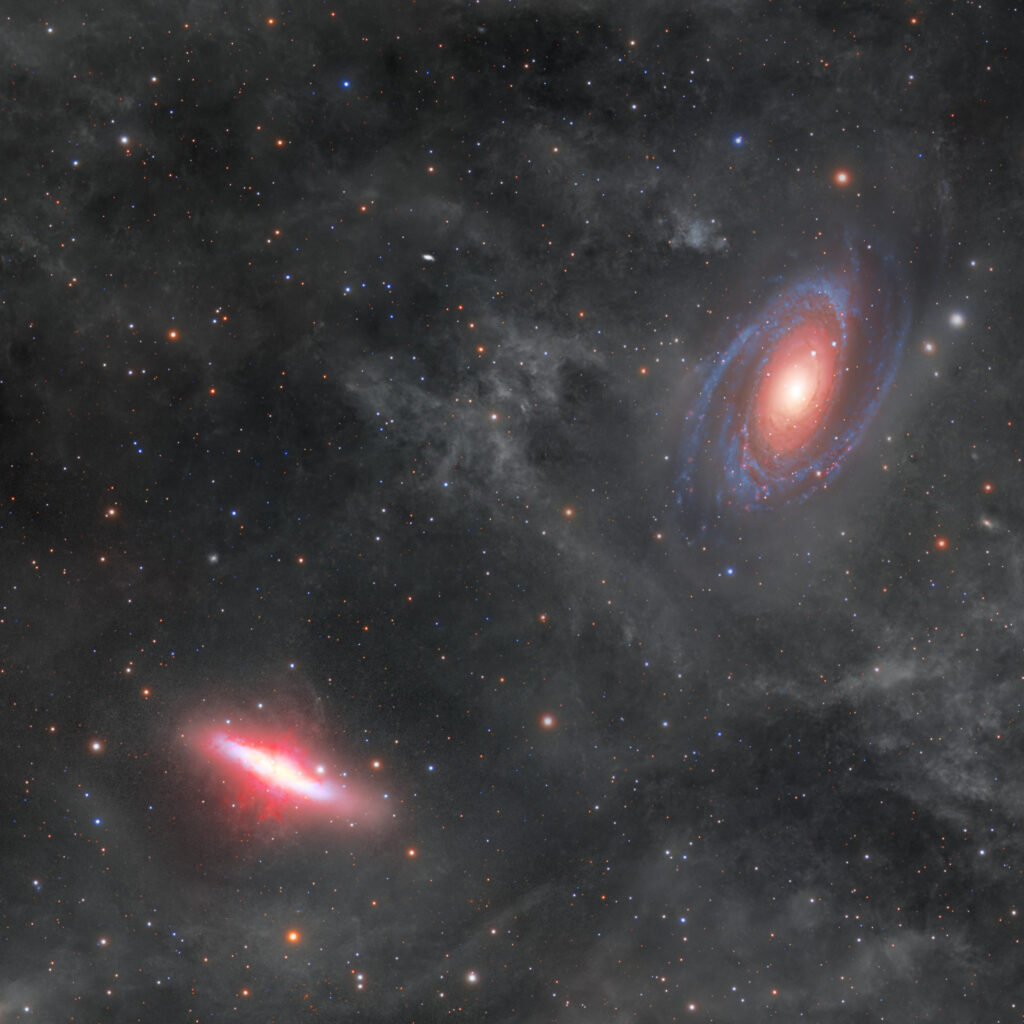
M81 (Bode’s Galaxy) dominates the right-center of the frame — a grand design spiral about 12 million light-years away, its arms rendered in cool blue star-forming regions wrapped around a warm, bulging core. It’s one of the brightest galaxies in the northern sky. With the hydrogen alpha exposures, I’m able to pull out purple nebulosity embedded within M82.
M82 (the Cigar Galaxy) sits below and to the left, and it’s anything but quiet. A starburst galaxy in the midst of a gravitational upheaval, M82 is hemorrhaging hydrogen gas in massive polar outflows driven by supernovae and stellar winds. The red tendrils erupting to the left and right from the disk are captured in Hα, a form of ionized hydrogen glowing at 656nm. It’s violent, chaotic, and beautiful. M82 is roughly five times more luminous than the entire Milky Way.
NGC 3077 completes the gravitational trio in the upper portion of the frame — a small companion caught in the same tidal web as its much larger neighbors, its edges visibly disturbed by the interaction.
And then there’s the IFN. Look at the background. That’s not noise, that’s not gradient, instead that’s the faint galactic cirrus clouds threading through the whole field. Bringing it out without crushing the star colors or blowing the galaxy cores or crushing the backround to pure black is one of the trickier processing challenges in astrophotography. Nearly 30 hours of Hα and a lot of masking work in Photoshop got me here.
Shot from Starfront Observatories, Brady, TX. More images on AstroBin under LurkingTaco.