
A Deep Narrowband Study of One of Amateur Astronomy’s Recent Discoveries
In an era where we think everything in the night sky has been catalogued, it’s remarkable that a massive nebula nearly a degree across remained undiscovered until 2011. The Giant Squid Nebula (Ou4) is a testament to what modern narrowband imaging can reveal—and a reminder that amateur astrophotographers are still making real discoveries.
The Subjects
This field showcases two distinct but overlapping structures:
- Sh2-129 (The Flying Bat Nebula): A large, faint H-II region spanning several degrees in Cepheus. Catalogued by Stewart Sharpless in 1959, this hydrogen emission nebula glows red from ionized hydrogen (H-alpha at 656.3nm) and sulfur (SII at 672.4nm). At roughly 2,300 light-years distance, the “bat wings” are sculpted by stellar winds and radiation from hot young stars embedded within the complex.
- Ou4 (The Giant Squid Nebula): The remarkable discovery. In May 2011, French amateur astrophotographer Nicolas Outters was imaging Sh2-129 with narrowband filters when his OIII frames (12.5 hours of integration!) revealed a massive bipolar structure that wasn’t visible in H-alpha or SII. He called it “le Calamar” (the squid) and contacted professional astronomer Agnès Acker, who confirmed the discovery. What is Ou4? Initially thought to be a planetary nebula, subsequent research suggests it’s actually a bipolar outflow driven by HR 8119—a triple system of hot, massive B-type stars visible near the center of the structure. The oxygen-III emission (500.7nm) creates that distinctive teal color, ionized by intense UV radiation from the central stars.
What’s a bipolar outflow?
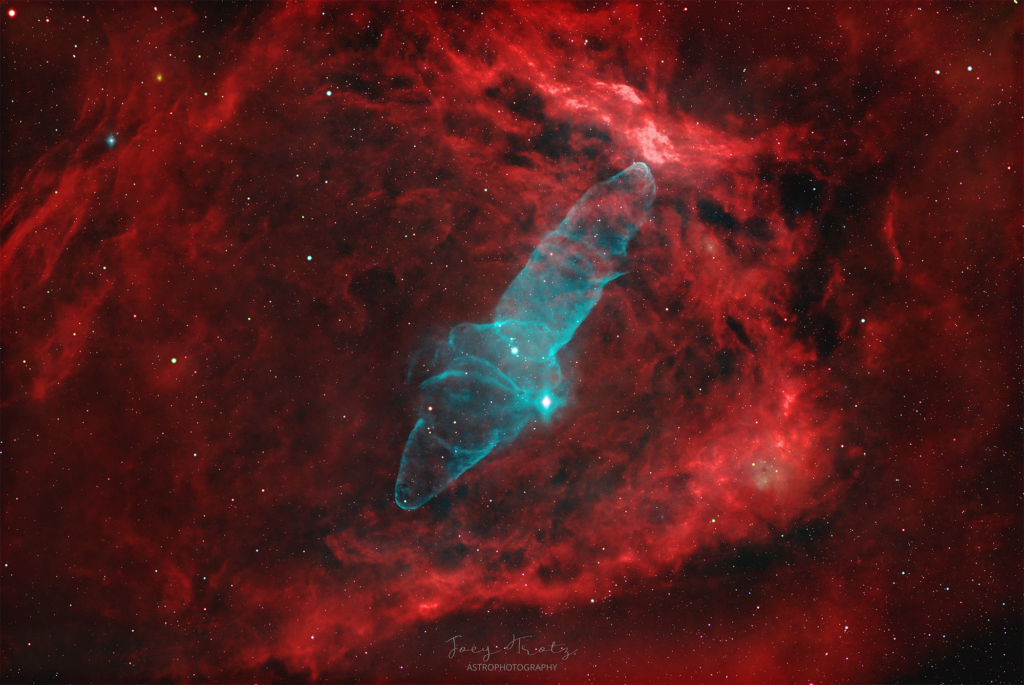
Imagine a garden sprinkler that only sprays water in two opposite directions—up and down, or left and right—instead of spinning in a circle. That’s essentially what’s happening with the Giant Squid Nebula.
The triple star system at the center (HR 8119) is blasting material out into space, but not in all directions equally. Instead, the gas shoots out in two opposite “jets” or streams, creating those distinctive tentacle-like lobes you see extending from the center.
Think of it like squeezing a balloon in the middle—the air escapes out both ends. In the Squid’s case, powerful stellar winds and radiation from the hot stars are forcing gas outward along two main axes, shaped by magnetic fields and possibly an accretion disk around the stars.
The oxygen in this gas gets ionized (charged up) by intense UV light from the central stars, which makes it glow in that distinctive teal color. We’re essentially seeing a cosmic “exhaust plume” that’s been running for about 90,000 years and has grown to be 50 light-years across.
The numbers are staggering: Ou4 is nearly 50 light-years across and approximately 90,000 years old. We’re witnessing a spectacular stellar wind event in progress.
The Challenge: Extreme Faintness
Ou4 is exceptionally dim—so faint that it escaped detection for decades despite Sh2-129 being a known object since 1959. Even with modern cameras and narrowband filters, it demands serious time to capture that faint blue signal.
That’s why I invested 26.5 hours into OIII imaging alone. This isn’t just about collecting photons—it’s about separating an incredibly faint signal from sky glow, readout noise, and thermal noise. Each 300-600 second sub barely hints at the structure. Only in the deep stack do those magnificent tentacles emerge from the darkness.
For context: most amateur images of bright nebulae use 3-10 hours total. This target demanded 32 hours, with the vast majority in a single filter, to reveal Ou4’s full glory.
Technical Approach: HOO Narrowband
Total Integration: ~32 hours
- OIII (500.7nm): 26.5 hours – Critical for the Squid
- H-alpha (656.3nm): 2.3 hours – For Sh2-129 and structural detail
- RGB: 3 hours for natural star colors
The HOO (Hydrogen-Oxygen-Oxygen) mapping:
- Red channel: Ha (Sh2-129’s emission)
- Green channel: OIII (transitional tones)
- Blue channel: OIII (Ou4’s emission)
This false-color palette isn’t just aesthetic—it’s functional. By mapping different ionization states to different colors, we can visually separate the Giant Squid (OIII outflow from the triple star) from the Flying Bat (H-II region ionized by the broader stellar association). The teal squid jumps out against the crimson bat, making both structures immediately apparent.
Equipment:
- Telescope: William Optics 81mm Gran Turismo WIFD
- Camera: ZWO ASI2600MM Pro (26MP mono, cooled to -10°C)
- Filters: Antlia 3nm narrowband (Ha, SII, OIII) + RGB
- Mount: ZWO AM5 Harmonic Drive Mount
- Location: Starfront Observatories, Brady, Texas
- Software: N.I.N.A. for acquisition, PixInsight for processing plus Photoshop, PiMagic and the Russ Croman Xterminator suite
A Discovery Made by Amateurs, For Amateurs
What strikes me most about Ou4 is that it was discovered by someone doing exactly what I’m doing—taking long narrowband exposures of known nebulae to see what details emerge. Nicolas Outters wasn’t conducting a professional sky survey with specialized equipment. He was using amateur gear and dedicating serious integration time to a faint target.
His discovery reminds us that there’s still real science happening in backyard (and remote) observatories. The combination of modern CMOS sensors, narrowband filters, and patient integration can reveal structures invisible to previous generations—even to the professional surveys of decades past.
The Starless Version: Pure Structure


Modern processing tools like Russ Croman’s StarXterminator allow us to separate stars from nebulosity, creating pure nebula images that showcase structure without stellar distraction. In the starless version, several features become clear:
- The Squid’s morphology: The bipolar lobes are clearly distinct, with a bright central “head” where HR 8119 resides
- Intricate tendrils: Fine filamentary structure throughout Ou4’s “tentacles”
- Depth and layering: You can see how Ou4 sits within (or in front of) the larger Sh2-129 structure
- Dark lanes: Barnard dark nebulae cutting through the emission
- The Bat’s wings: Faint extensions of Sh2-129 become visible without bright stars overwhelming them
The starless version also makes it obvious why this was such a difficult discovery—remove the reference frame of stars, and you’re left with incredibly subtle, low-contrast nebulosity that requires perfect processing to reveal.
Processing Notes
OIII Signal Extraction: With 26.5 hours of OIII data, signal-to-noise was excellent, but the raw signal is still extremely faint. Multiple iterations of deconvolution, careful noise reduction, and multi-scale processing were essential to bring out the finest details without introducing artifacts.
Dynamic Range: The bright HR 8119 star system versus the faint outer tendrils of Ou4 presented significant challenges. HDR techniques and luminance masking preserved detail across the range.
Color Balance: HOO palettes can easily become oversaturated or unrealistic. I aimed for rich but believable colors—deep crimsons in the H-alpha regions, vibrant but not garish teal in the OIII, with smooth gradients between ionization zones.
Star Restoration: The narrowband HOO data produces strange star colors, so I used RGB star data to restore natural stellar hues while preserving the enhanced HOO nebula palette—a hybrid approach that’s both scientifically meaningful and visually appealing.
The Science Behind the Beauty
Ou4 represents a spectacular example of stellar feedback—how massive stars shape their environment through radiation pressure and stellar winds. The bipolar morphology suggests:
- Collimated outflows: Material channeled along specific axes, possibly by magnetic fields or an accretion disk
- Triple star dynamics: HR 8119’s triple nature may contribute to the asymmetric structure
- Interaction with ISM: The surrounding Sh2-129 material constrains and shapes the outflow
At 90,000 years old, Ou4 is young in cosmic terms. Over millions of years, it will continue expanding, eventually dispersing into the interstellar medium and enriching it with processed materials—oxygen, in this case, created in the cores of the massive stars and expelled in these spectacular winds.
What’s Next?
I’m planning to revisit this region with:
- Additional H-alpha time to better balance the SHO channels
- Adding SII signal to show more complexity in the Flying Bat
- Wider field imaging to capture more of the Sh2-129 complex
- Potentially even deeper OIII to reveal the faintest outer tendrils
This is one of those targets I could image for a long time —there’s always more signal hiding in the noise, waiting to be revealed.
Conclusion: Standing on the Shoulders of Amateurs
Every time I image Ou4, I think about Nicolas Outters pointing his telescope at Sh2-129 in May 2011, processing those OIII frames, and realizing he was seeing something new. A structure nearly a degree across, 2,300 light-years away, 50 light-years in physical size—and yet invisible until an amateur astronomer dedicated enough time to reveal it.
That’s the promise of modern astrophotography: we’re not just capturing pretty pictures, we’re genuinely exploring the universe. Every deep integration has the potential to reveal something previously unseen. That’s what the founder of my remote observatory did a few years back – he spent a crazy-long amount of time – we’re talking hundreds of hours – exposing OIII of the very-frequently imaged Andromeda Galaxy and ended up discovering a beautiful blue arc of previously unkown nebulostiy that appears just above M31.
The photons that created this image left the Squid and Bat around 300 BCE—roughly when the Colossus of Rhodes was being built. They traveled through 2,300 years of space, finally landing on my camera sensor in the winter of 2025, revealing a cosmic creature discovered only 14 years ago.
Clear skies, and keep looking up—you never know what you might find. 🦑🦇✨
Image Gallery:
- Full HOO+RGB blend (stars)
- Starless version (pure nebulosity)
Technical Data:
- Integration Time: 31.92 hours
- Frames: 217 lights
- Imaging Dates: November 17 – December 9, 2025
- Location: Brady, Texas
- Processing: PixInsight
References:
- Outters, N. (2011). Discovery of Ou4
- Corradi et al. (2014). “Gas physical conditions and kinematics of the giant outflow Ou4”
- Sharpless Catalog: Sh2-129
- Distance: ~2,300 light-years