
A Deep Dive into Winter’s Crown Jewel
Of all the objects in the night sky, few capture the imagination quite like M42—the Great Orion Nebula. Visible to the naked eye as a fuzzy “star” in Orion’s sword, even under moderately light-polluted skies, it’s been observed for millennia. This was one of the first deep-space objects I ever tried to photograph (back around 2018), but there’s always something new to discover.
The Subject
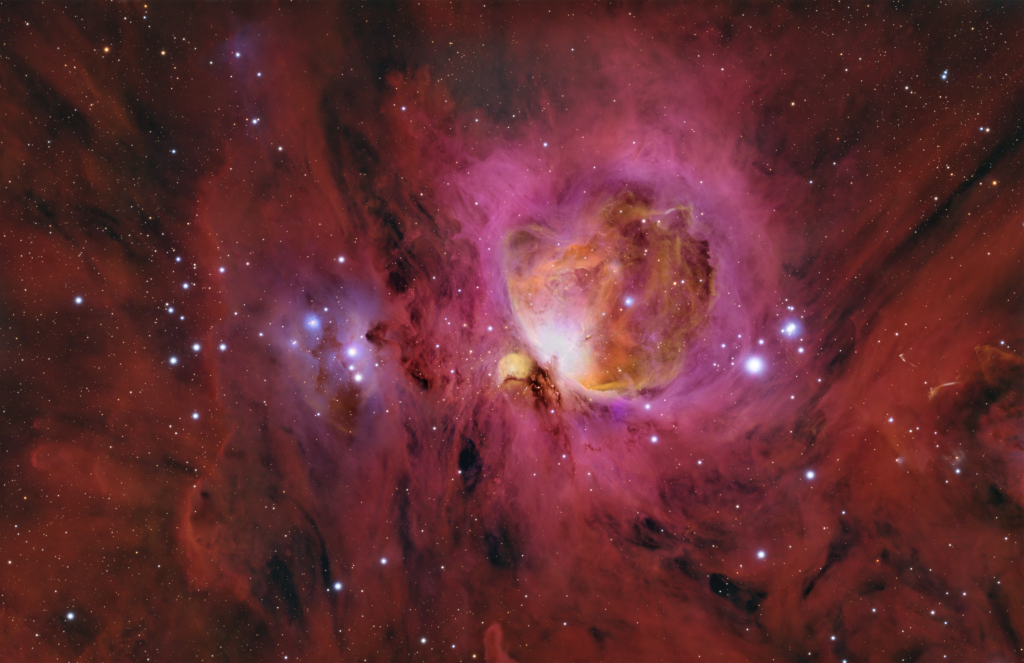
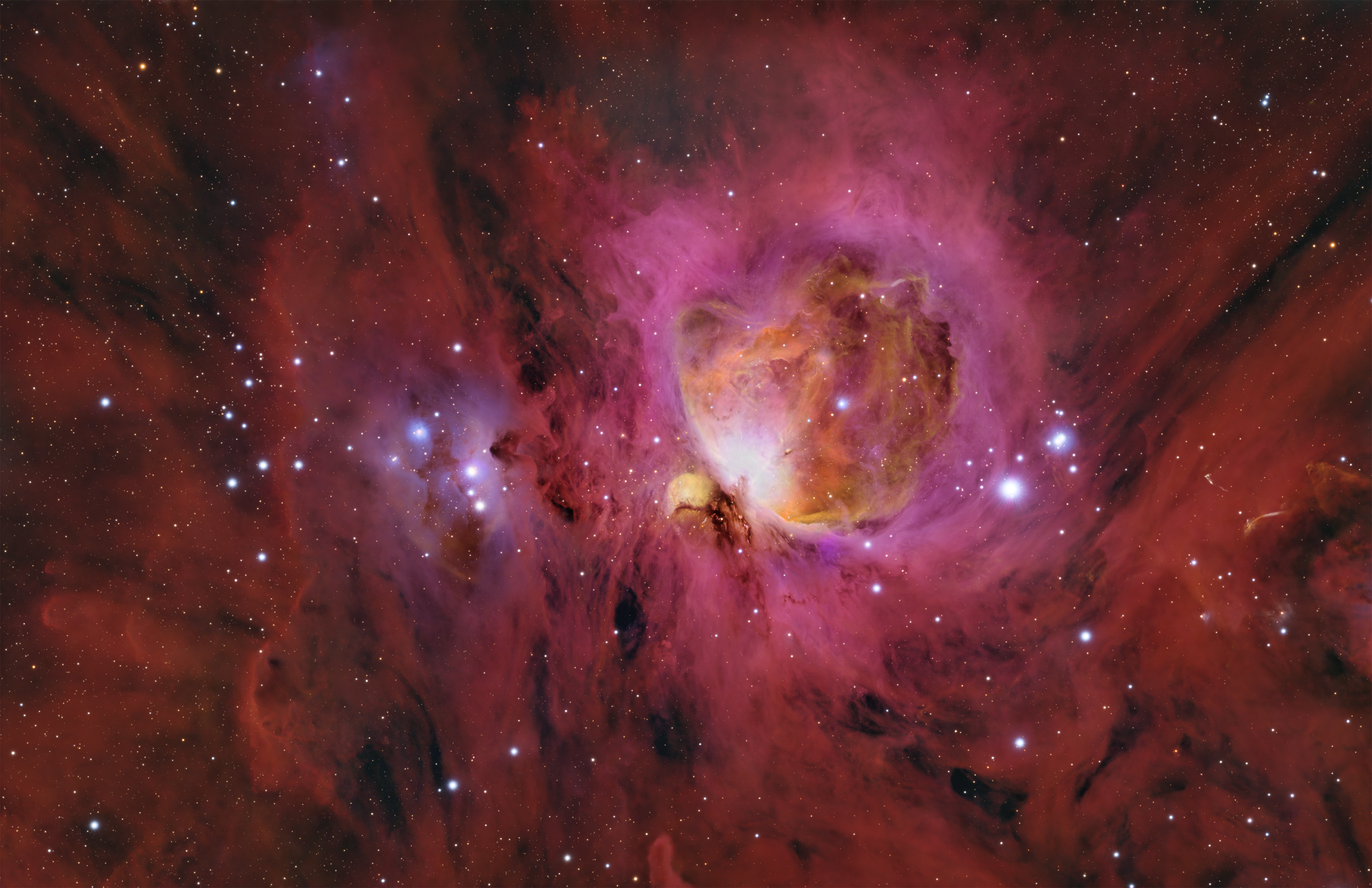
M42 sits just 1,350 light-years from Earth, making it one of our closest stellar nurseries. The brilliant core is dominated by the Trapezium Cluster—four massive young stars (θ¹ Orionis A, B, C, and D) that pump out intense ultraviolet radiation, ionizing the surrounding hydrogen gas and causing it to glow. These stars are incredibly young in cosmic terms—only about 300,000 years old, compared to our 4.6-billion-year-old Sun.
To the left (north) of the main nebula complex, you’ll find NGC 1973/1975/1977, collectively known as “The Running Man Nebula.” Unlike M42’s emission nebula (glowing gas), these are reflection nebulae—clouds of dust that scatter the light from nearby stars, creating those distinctive blue regions. The contrast between the two types of nebulae in a single frame is one of the things that makes this region so visually compelling.
A New Discovery (for Me)
After over a dozen different multi-night sessions on M42 over the years, this was the first time I’ve captured the bow shock structure near IC 428 on the right side of the frame. It appears as a delicate arc—the result of a fast-moving star plowing through the interstellar medium and compressing the gas ahead of it. Think of it like a boat creating a wake, except this wake is light-years across and carved through tenuous clouds of hydrogen and dust.


The past is often the best teacher: It’s good to look back on how we progress through life, and astrophotography is as humbling a hobby as I’ve ever attempted. I feel pretty good about how I’ve progressed! At left, my first ‘successful’ attempt at Orion (early 2018). Awful focus, very little detail, zero color, but let me tell ya – was I ever excited! A few months later while camping under the very dark skies of the Okefenokee Swamp I captured this color version (right).
These subtle structures require significant integration time to reveal, and they’re often lost in shorter exposures or overwhelmed by the bright core. The deep narrowband data, particularly the Hα and SII channels, brought out details I’d never seen in my previous attempts at this target.
Technical Approach: SHO Narrowband + RGB
This image represents approximately 40 hours of total integration time collected over multiple nights between December 2025 and January 2026 from my remote observatory in Brady, Texas. For more detail, visit my Astrobin post of this capture.
Narrowband Imaging (36.5 hours):
- Hα (656nm): 14 hours – Maps to red, capturing ionized hydrogen
- SII (672nm): 11.8 hours – Maps to red, capturing ionized sulfur
- OIII (496nm): 10.7 hours – Maps to blue/green, capturing ionized oxygen
RGB for Star Colors (3 hours):
- Red, Green, Blue filters: 1 hour each
The SHO (Sulfur-Hydrogen-Oxygen) palette, popularized by the Hubble Space Telescope, reveals structures that would be invisible in traditional RGB imaging. The teal/cyan regions show oxygen-rich areas, the deep reds highlight sulfur emissions in the outer wings, and the magentas represent hydrogen-dominated regions in the core.
By blending the narrowband SHO data with RGB star color data, I was able to maintain natural-looking star colors while preserving the enhanced nebula detail that narrowband provides. It’s the best of both worlds—scientific revelation with aesthetic appeal.
Equipment:
- Telescope: William Optics 81mm Gran Turismo WIFD (dedicated 6-element flat-field apo)
- Camera: ZWO ASI2600MM Pro (26MP mono) cooled to -10°C
- Mount: ZWO AM5 Harmonic Drive Equatorial Mount
- Filters: Antlia 2″ narrowband (2.5nm) and RGB
- Imaging software: N.I.N.A. (Nighttime Imaging ‘N’ Astronomy), Open PHD Guiding Project PHD2
- Processing software: Pleiades Astrophoto PixInsight, Adobe Photoshop, PiMagic Studio, Russ Croman’s Xterminator Suite, Tenmon
Processing Notes
One of the challenges with M42 is the extreme dynamic range—the core is incredibly bright while the outer regions are faint. This required careful HDR blending techniques to preserve detail in both the overexposed Trapezium region and the delicate outer filaments. Honestly, that part needs work.
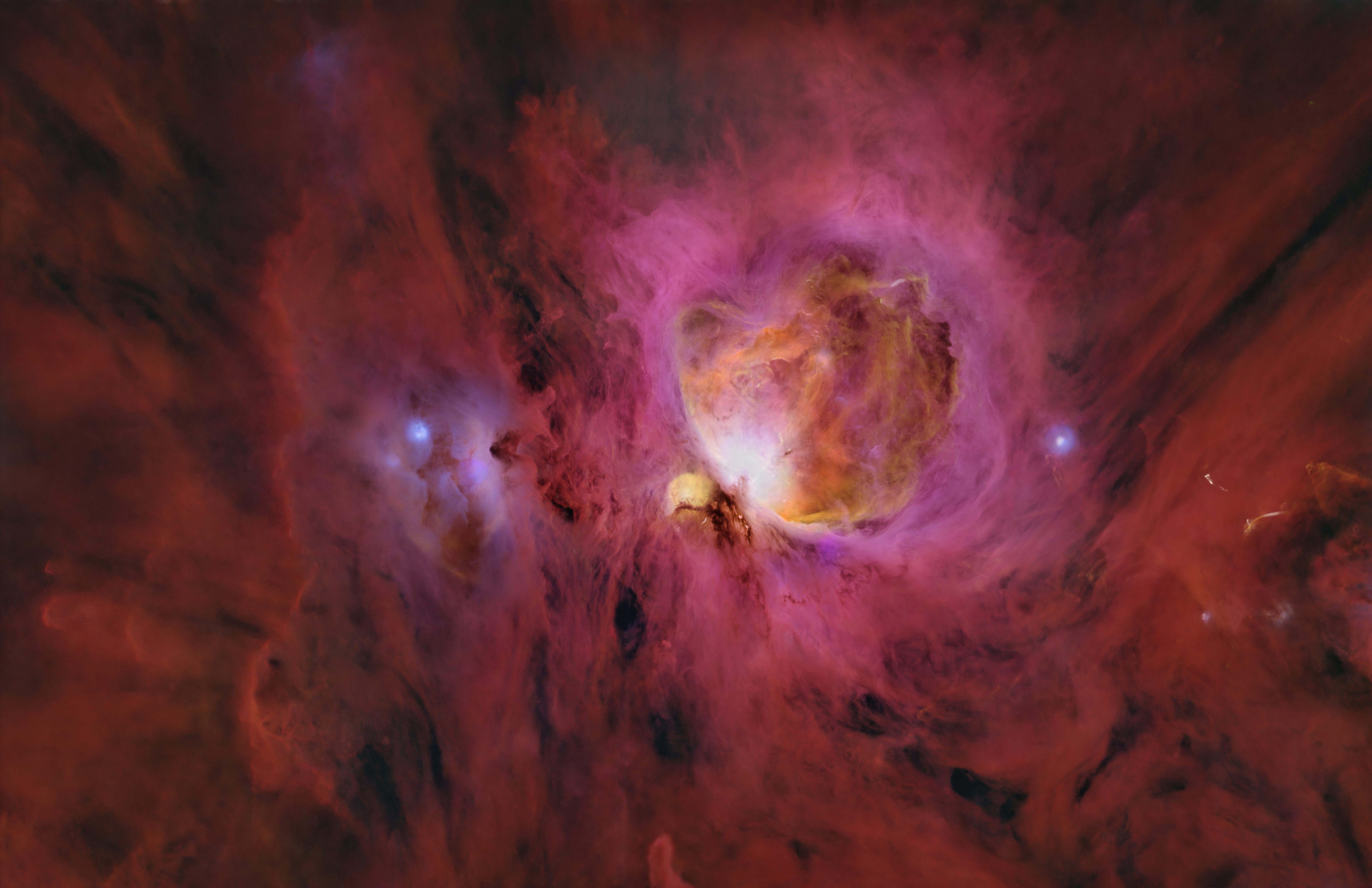
The starless version (see comparison above) really showcases the nebula structure without the visual distraction of the stellar field. You can see the intricate filaments, the dark absorption lanes (Barnard’s Loop extensions), and the subtle color gradients that reveal the composition and temperature variations throughout the nebula. As I process my astro images, it’s very typical to separate the stars from the nebulosity. Thankfully, software now makes this simple, allowing extreme stretching of the starless image to bring out all the desired detail.
The Bigger Picture
M42 isn’t just beautiful—it’s a laboratory for understanding star formation. Right now, within those clouds, hundreds of stars are being born. Some are still hidden behind thick veils of dust, detectable only in infrared, probably soon to be imaged by the JWST which sees in infrared. Others are just beginning to clear away their natal cocoons and shine through.
Every photon that reached my camera sensor traveled 7.8 quadrillion miles (1,350 light-years) to tell this story. The light left this nebula around 675 CE—roughly when the first Vikings were beginning their raids on Europe. That same light was traveling through space while civilizations rose and fell, finally arriving at my telescope in the winter of 2025-2026.
What’s Next
I’m planning to revisit this region with even deeper integration, possibly targeting 80-100 hours total. There are faint outer regions of the nebula complex—particularly the massive Barnard’s Loop and the surrounding H-alpha structures—that would benefit from additional exposure time and mosaic of multiple panels. I’d also like to capture more luminance data to bring out the finest details in the Running Man region.
You can view the full-resolution version and the starless processing variant in the gallery below. As always, feel free to reach out with questions about the imaging process or equipment!
Technical Data:
- Integration Time: 39.5 hours
- Frames: 786 lights (see acquisition details on Astrobin)
- Imaging Dates: December 2-19, 2025 & January 2026
- Location: Starfront Observatories, Brady, Texas
- Bortle Class: 1/2