
From Starfront Observatories near Brady, Texas – IC 2118, the Witch Head Nebula, emerges from the cosmic darkness in not too far away in our nighttime sky from the famous Great Orion Nebula. This object, however, is a faint reflection nebula sitting approximately 900 light-years away, meaning the photons in this image began their journey around the year 1125 – during the height of the Crusades and the construction of Europe’s great cathedrals.
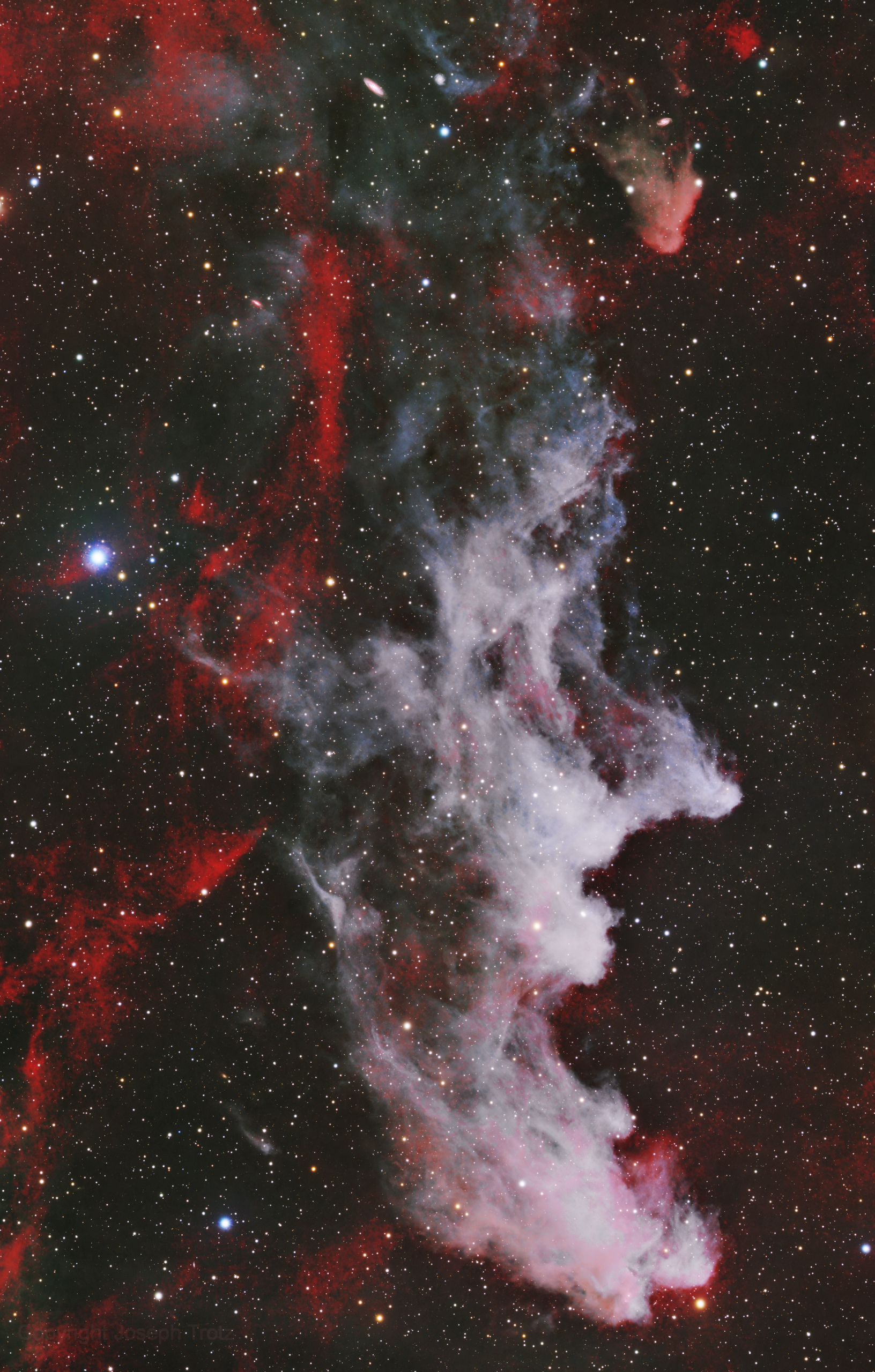
The nebula’s distinctive profile resembles a witch in silhouette, complete with a pointed chin and hooked nose. Its ethereal blue glow comes from the scattered light of nearby Rigel, Orion’s brilliant blue supergiant star. Dust grains in the nebula scatter blue light more efficiently than red, creating this haunting cobalt hue against the darkness of space.
Here, I chose to capture the nebula in ‘normal’ colors – Red, Green and Blue. But I also included a lot of exposure time in hydrogen-alpha, revealing the intricate filaments of ionized hydrogen threaded throughout the nebula.This molecular cloud spans roughly 70 light-years and represents an active region of star formation, where future stellar systems are condensing from the cosmic dust.
Acquisition Details: 📍 Starfront Observatories, Brady, TX 📅 November 22, 25-26, December 1-2, 11-20, 27, 2025 ⏱️ 46.4 hours total integration time
- Luminance: 153 × 5min (12.8 hrs)
- Red: 35 × 5min (2.9 hrs)
- Green: 37 × 5min (3.1 hrs)
- Blue: 38 × 5min (3.2 hrs)
- H-alpha: 94 × 10min (15.7 hrs)
🔭 Antlia LRGB + 3nm H-alpha filters 🎯 Unbinned sensor
Fifteen nights of remote imaging across fall and winter to capture this spectral apparition haunting the skies near Orion.
#astrophotography #deepsky #nebula #eridanus #ic2118 #witchhead #witchheadnebula #reflectionnebula #rigel #lrgb #halpha #narrowband #remoteastronomy #starfrontobservatories #bradytx #darkskies #astronomy #nightsky #spaceiscool #astrobin #orion