
This one has been on my radar for a while — and I finally did it justice.
I’ve pointed a telescope at the Cone Nebula before, but from my Bortle 8 backyard in Atlanta, I couldn’t pull much out of it. Light pollution is the enemy of faint nebulosity, and this region has plenty of both. Moving my rig to Starfront Observatories out near Brady, Texas — where the skies are genuinely dark — changed everything. Nearly 48 hours of integration time later, this is what came back.
The Subject
This field sits about 2,500 light-years away in the constellation Monoceros, right next door to the region I imaged for the Seagull Nebula. At the heart of the frame is NGC 2264 — a designation that covers both the Christmas Tree Cluster and the Cone Nebula, which are part of the same star-forming complex. The “tree” is the open cluster of young stars, arranged (with some imagination and the right orientation) like a Christmas tree. The “cone” is the dark pillar of gas and dust rising from the bottom of the frame — a dense column of cold molecular cloud being slowly eroded by the intense radiation from those same hot young stars.
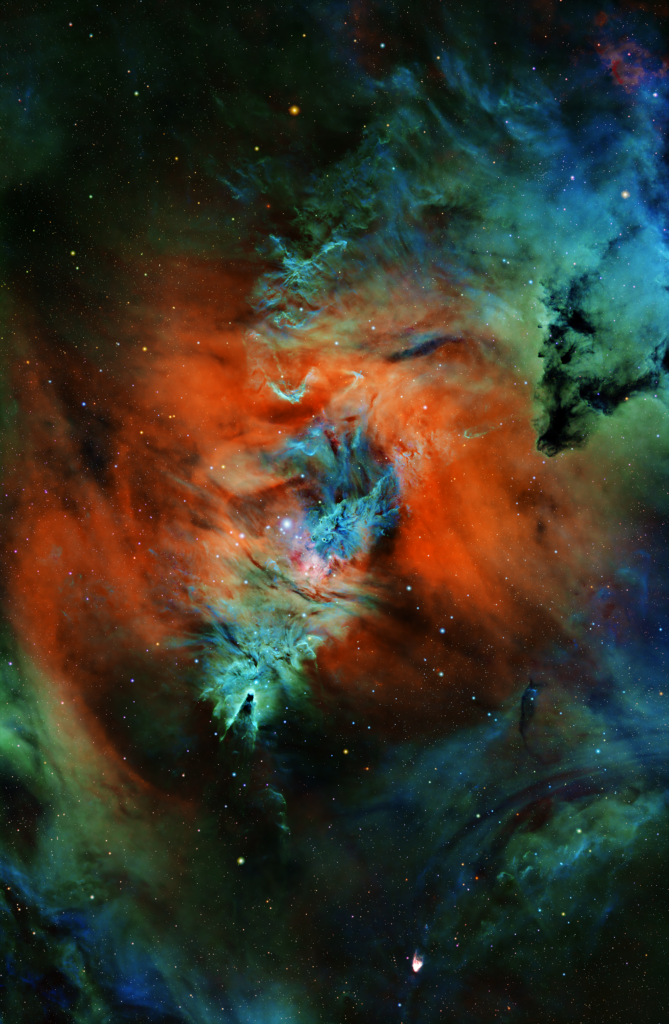
Tucked into the lower right of the frame is Hubble’s Variable Nebula (NGC 2261) — a small but fascinating reflection nebula that famously changes in appearance over weeks and months as dust clouds near the embedded variable star R Monocerotis cast shifting shadows across it. It was the very first object photographed through the newly dedicated Palomar 200-inch telescope in 1949. That little ghostly smear in the corner has some history.
The light in this image left during the early Bronze Age. Every photon that hit my sensor traveled roughly 14 quadrillion miles to get here. I think it was worth the wait. 🌌
The SHO Palette
This is a narrowband SHO image — Sulfur-II mapped to red, Hydrogen-alpha to green, and Oxygen-III to blue — combined with RGB data for natural star colors. The SHO (or “Hubble”) palette is what gives the image that vivid orange-teal look: the deep oranges and reds represent sulfur and hydrogen-rich regions, while the teal and cyan filaments threading through the nebula are oxygen-dominated zones energized by the cluster’s young, hot stars.
The Cone itself shows up as a dark intrusion against that orange glow — a shadow of cold, dense gas blocking the emission behind it. Getting that level of structural detail in the pillar is something that simply wasn’t achievable from my backyard. Dark skies matter.
Integration Details
Total: 48 hours, 10 minutes collected from Starfront Observatories in Brady, Texas.
- Hα: 18h 30m
- SII: 9h 25m
- OIII: 8h 25m
- Luminance: 6h 20m
- RGB: 1h 50m each (R/G/B)
Equipment:
- Telescope: William Optics Gran Turismo 81mm WIFD
- Camera: ZWO ASI2600MM Pro
- Mount: ZWO AM5
- Filters: Antlia 2.5 nm narrowband (Hα, SII, OIII) and RGB
- Software: N.I.N.A., PHD2, PixInsight, Photoshop, PiMagic Studio, Russ Croman’s Xterminator Suite
Full acquisition details are on Astrobin.
A Note on Processing
The SHO palette on this target tends toward a very orange-dominant look because of how hydrogen-saturated the entire region is. Getting teal separation into the oxygen-rich filaments without making the whole thing look artificial took some work. The luminance data helped significantly with fine detail in the Cone structure itself — I don’t always add a luminance channel to narrowband images, but for dark structures against bright nebulosity, it earns its place.
This is the version I’m happy with. Ask me again in six months and I’ll probably say it needs more OIII. 😄